
Intro
If you have ever opened a sportsbook in Nigeria, chances are you have already used decimal odds — even if you did not know the format’s official name. The numbers are familiar to almost every football bettor: 1.55, 2.10, 3.75, 8.00.
Decimal odds at Nigerian bookmakers
This is the most commonly used type of odds in Nigerian betting
Understanding decimal odds is not just a beginner skill. It sits at the center of football betting literacy. Whether you are building an accumulator, exploring live betting opportunities, or trying to understand why bookmakers price one team as a strong favorite and another as a risky outsider, decimal odds shape the entire betting conversation.
If you are new to betting theory, this guide works naturally alongside our complete explanation of How Football Odds Work, which explores the broader logic behind football pricing and bookmaker probability.
How Decimal Odds Actually Work
At first glance, decimal odds look almost too simple. A football match may show:
Nigeria — 2.20
Draw — 3.10
Ghana — 3.40
Those numbers are not random sportsbook decoration. They represent the total return a bettor receives for every unit staked if the prediction wins.
If you place ₦5,000 on Nigeria at 2.20 odds, your total payout would be ₦11,000. That figure includes: your original stake and your profit. This distinction matters because beginners often confuse payout with winnings.
Decimal odds do not show pure profit. They show total return.
That simplicity is one reason Nigerian bettors tend to prefer decimal pricing. The calculation works naturally inside sportsbook apps, mobile betting interfaces, and accumulator slips without forcing users to convert fractions or interpret unfamiliar plus-and-minus symbols.
Compare that with American odds, where bettors may encounter numbers like +180 or -145, or traditional UK-style Fractional Odds such as 5/2 or 11/4. Decimal odds remove friction from the process. Modern bettors move quickly between:
- match winners,
- goals markets,
- live odds,
- and same-game combinations.
Decimal pricing fits that environment naturally.
Why Decimal Odds Dominate Nigerian Football Betting
Betting culture changes from market to market. In Britain, many long-time bettors still recognize fractional odds instinctively. In the United States, American odds remain deeply embedded in sportsbook culture.
Nigeria developed differently. The rapid growth of mobile sportsbooks, football betting apps, and digital wagering platforms helped establish decimal odds as the default language of betting.
Today, for most Nigerian bettors, decimal odds are not simply popular — they are normal. You see them on:
- Premier League fixtures,
- NPFL matches,
- Champions League markets,
- virtual football,
- and live betting screens.
That familiarity matters because betting decisions often happen quickly. A bettor checking a late Champions League match from Lagos, Abuja, or Port Harcourt does not want to stop and translate pricing systems. Decimal odds communicate information instantly. A market priced at 1.35 immediately suggests a strong favorite. A line around 2.00 feels balanced. An outcome priced at 7.50 signals significant risk and a larger potential reward.
The language becomes intuitive. This is one reason decimal odds work particularly well in football betting environments built around speed, mobile access, and accumulator culture. And few betting audiences embrace accumulators more enthusiastically than football fans.
Using Decimal Odds in Real Football Betting
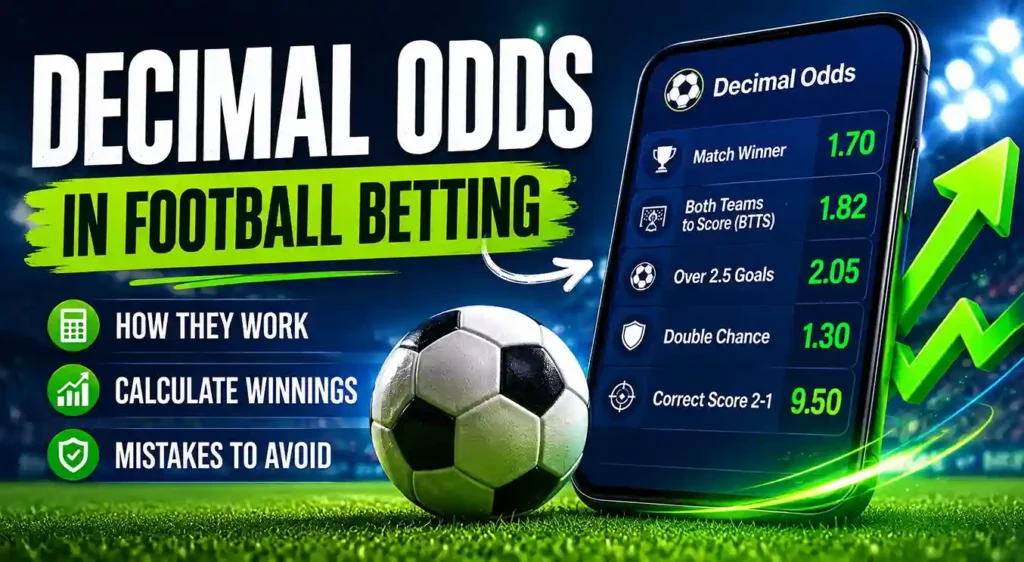
Decimal odds become more meaningful when you see them applied to real football markets instead of abstract examples. Imagine a typical Saturday Premier League betting coupon where you might encounter prices such as BTTS at 1.82, Over 2.5 Goals at 2.05, Double Chance at 1.30, and Correct Score 2–1 at 9.50. Even without any explanation from the bookmaker, these numbers already communicate different levels of expectation. The lower-priced double chance option signals a higher probability outcome with smaller potential returns, while the much higher 9.50 correct score line reflects a far less likely and more difficult prediction.
At this point, decimal odds stop being just a calculation format and start functioning as a way of interpreting how the market views a football match. A bettor who understands pricing begins to ask more meaningful questions, such as why BTTS is priced shorter than Over 2.5 goals, why a 1–1 scoreline carries different odds compared to 2–1, or why a live price might shift from 2.10 to 1.75 after an early red card. These movements and differences are essentially clues that reveal how bookmakers assess probabilities. That is also why decimal odds naturally connect to topics like BTTS betting, Over/Under markets, and correct score wagering, since all of them rely on the same underlying logic: odds are condensed expressions of expected outcomes rather than random numbers.
Calculating Returns With Decimal Odds
The logic behind calculating returns with decimal odds is intentionally simple, which is one of the reasons this format is so widely used. Your total payout is determined by multiplying your stake by the decimal odds, meaning payout equals stake multiplied by decimal odds. This simplicity makes it easy for bettors to understand potential returns instantly without needing complex conversions or separate profit tables.
For example, if you stake ₦10,000 on Arsenal to win at odds of 1.90, your total return would be ₦19,000, giving you a profit of ₦9,000. If you move into a higher-risk market, such as placing ₦2,000 on a correct score prediction at 8.50 odds, your total return increases to ₦17,000. This contrast highlights a fundamental principle of betting: higher decimal odds generally reflect lower probability outcomes but offer significantly larger potential rewards. T
Decimal Odds and Accumulator Culture
Decimal odds work particularly well with accumulator betting because the format makes it easy to see how combined bets build value. When multiple selections are placed together, each individual odd is multiplied by the next, causing the total potential return to grow quickly. For example, if a bettor combines Liverpool to win at 1.70, BTTS Yes at 1.85, and Over 2.5 Goals at 1.95, the accumulator odds are calculated simply by multiplying these values together, resulting in a rapidly increasing total.
This is also why decimal odds are so closely associated with accumulator strategies and multi-selection betting approaches, where the appeal lies in turning modest probabilities into significantly amplified returns.
Decimal Odds Compared With Other Formats
Understanding decimal odds becomes easier when contrasted with alternative systems. Take a football outcome priced at even probability. You might see:
| Decimal | Fractional | American |
|---|---|---|
| 2.00 | 1/1 | +100 |
All three formats express essentially the same betting position. The difference lies in presentation.
- Decimal odds emphasize total return.
- Fractional odds focus on profit relative to stake.
- American odds frame pricing through positive and negative numbers linked to $100 calculations.
None of these systems is inherently “better.” They are simply different betting languages. However, for most Nigerian bettors, decimal odds remain the most accessible and practical option. That does not mean other systems are irrelevant.
If you follow international sportsbooks or UK racing culture, understanding Fractional Odds can be useful. Likewise, bettors exploring American sportsbooks may eventually encounter American Odds. But inside mainstream Nigerian football betting, decimal pricing remains the dominant standard.
What Decimal Odds Reveal About Probability
One of the most valuable aspects of decimal odds is that they quietly communicate probability. A market priced at 1.25 suggests the bookmaker sees that outcome as highly likely. An outcome priced at 6.50 signals far lower confidence. There is a mathematical relationship behind this.
You do not need to become a professional statistician to benefit from this concept. Even a basic understanding changes how bettors read football markets. Instead of asking only: “Can this team win?” you begin asking: “Does the probability justify the price?”
That shift matters. It moves betting away from emotion and closer to market interpretation. And that transition often separates casual betting behavior from more analytical football thinking.
Common Mistakes Bettors Make With Decimal Odds
Despite their apparent simplicity, decimal odds are often misunderstood in ways that lead bettors to misjudge both risk and reward. One of the most frequent mistakes is confusing total payout with actual profit. For example, when a bettor sees odds of 2.50 and stakes ₦5,000, it is easy to incorrectly assume the return represents ₦12,500 in profit, when in reality that figure is the total payout and the real gain is significantly lower. This kind of misunderstanding might seem minor, but over time it can distort expectations and lead to poor staking decisions.
This distinction becomes especially important in emotionally driven football betting environments, where fans often mix club loyalty with wagering decisions. Supporting a team and correctly assessing market value are not always aligned, and this gap is where many betting mistakes originate. Decimal odds can help introduce discipline into this process, but only if they are understood as a pricing system rather than a visual scale of attractiveness. This idea is explored further in Understanding Double Chance Betting in Football Matches and also connects closely with A Beginner’s Guide to Football Handicap Betting, where pricing logic is just as important as match outcomes.
Reading Football Through Decimal Odds
More experienced bettors gradually shift the way they interpret decimal odds, moving away from seeing them as simple payout multipliers and instead treating them as a form of football intelligence. In this mindset, odds are no longer just numbers attached to bets, but reflections of how the market collectively understands a match. A sudden shift from 2.20 to 1.85, for instance, is rarely random; it may signal breaking team news, late injury updates, unexpected lineup changes, or a wave of sharp market confidence influencing the price.
In this sense, learning decimal odds goes far beyond basic calculation. It becomes a way of understanding how sportsbooks interpret football, weight uncertainty, and translate match dynamics into pricing. For bettors operating in fast-moving environments such as Nigeria’s sportsbook market, this skill becomes particularly valuable, as it allows them to read not just the game on the pitch, but also the shifting logic of the market behind it.
Final Thoughts
Decimal odds are more than the standard betting format used by Nigerian bookmakers. They are the operating language of modern football betting. Their popularity comes from simplicity, speed, and clarity. They work naturally across single bets, accumulators, live betting markets, and goal-based football wagers.
And whether you are exploring How Football Odds Work, comparing American Odds format and Fractional Odds, or building a Saturday football accumulator, decimal odds remain one of the most important foundations of betting literacy.
FAQ
1️⃣ What are decimal odds in football betting?
Decimal odds are a betting format that shows how much a bettor will receive for every unit staked, including the original stake. For example, odds of 2.50 mean that a ₦1,000 bet would return ₦2,500 in total if successful.
2️⃣ What type of odds are used in sports betting in Nigeria?
In Nigeria, the most commonly used odds format in sports betting is decimal odds. This system is widely adopted by local and international bookmakers operating in the country because it is simple, transparent, and easy to understand. Decimal odds show the total return a bettor will receive for every unit staked, including the original stake.
3️⃣ How do I calculate winnings using decimal odds?
To calculate total returns, you simply multiply your stake by the decimal odds. For instance, a ₦5,000 stake at 1.80 odds results in a ₦9,000 total payout, which includes both profit and the original stake.
4️⃣ Why do short odds like 1.40 or 1.60 feel less attractive?
Short odds represent high-probability outcomes, which usually come with lower returns. While they may seem less exciting, they often reflect more realistic expectations compared to high-risk, long-shot selections.
5️⃣ Are higher odds always better for profit?
Not necessarily. Higher odds offer larger potential returns but also indicate lower probability of success. Successful betting is about finding value, not just chasing big numbers.
| You may also read ✅ Want a broader picture beyond decimal pricing? Explore the hidden logic behind how football odds are built and interpreted. ✅ Curious why British bookmakers still favour 5/2 and 11/8? Discover the traditional language of fractional football betting. ✅ If odds like +150 and -200 still look confusing, learn how American sportsbooks express value through pluses and minuses. |

Read more >>
- Prediction for the match “Manchester City” vs “Everton” on October 18, 2025. The inspired attack of the “Toffees” will score in Manchester. - 14.10.2025
- Prediction for the Nottingham Forest vs. Chelsea match on October 18, 2025. There will be at least three goals in the Foresters’ game. - 14.10.2025
- Prediction for the match “Barcelona” vs. “Girona” on October 18, 2025. Barcelona’s defense will once again be unable to keep a clean sheet. - 14.10.2025


