
Introduction
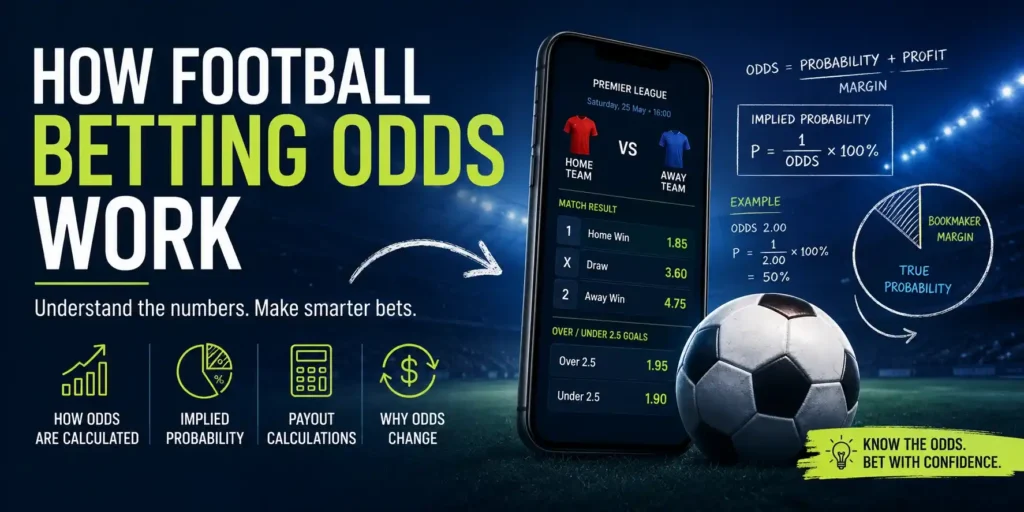
Football betting odds are the foundation of every sports bet. Whether you are betting on the Premier League, Champions League, La Liga, or local Nigerian football competitions, understanding how odds work is essential before placing your first wager.
Odds determine how much money you can win, but they also reveal how bookmakers evaluate the probability of a particular outcome. Once you understand how football odds work, you can make smarter betting decisions, compare value between markets, and avoid many of the mistakes beginners commonly make.
In this guide, you will learn:
- what football betting odds mean,
- how bookmakers calculate odds,
- how to read different odds formats,
- how implied probability works,
- why odds change before matches,
- and how to calculate potential winnings.
By the end of this article, you will have a strong understanding of how football betting markets operate.
What Are Football Betting Odds?
Football betting odds represent the probability of a specific outcome happening in a match. They also determine how much a bettor can win if the prediction is correct.
Every football match usually has three main possible outcomes:
- Home win
- Draw
- Away win
For example:
| Outcome | Odds |
|---|---|
| Arsenal Win | 1.80 |
| Draw | 3.50 |
| Chelsea Win | 4.20 |
In this example:
- Arsenal are considered the favorites,
- Chelsea are the underdogs,
- and the draw is viewed as moderately likely.
The lower the odds, the more likely bookmakers believe the outcome is. Higher odds suggest a lower probability but a larger potential payout.
Football odds are not random numbers. They are carefully created using statistics, market analysis, betting activity, and bookmaker profit margins.
How Bookmakers Calculate Odds
Bookmakers use complex systems and data models to calculate football odds. Their goal is not only to predict outcomes accurately but also to balance betting action while ensuring long-term profit.
Several factors influence football betting odds.
Team Form
Recent performances play a major role. A team that has won five matches in a row will usually receive lower odds than a team struggling with poor results.
Bookmakers analyze:
- recent wins and losses,
- goals scored,
- defensive records,
- home and away form,
- and overall consistency.
Injuries and Suspensions
Missing key players can significantly affect odds. If a star striker or important defender is ruled out before kickoff, bookmakers may quickly adjust prices.
For example:
- if a team loses its top scorer,
- the odds for that team to win may become higher,
- while the opponent’s odds may shorten.
Home Advantage
Home teams often perform better due to:
- familiar conditions,
- fan support,
- reduced travel fatigue,
- and stadium atmosphere.
Because of this, bookmakers usually favor teams playing at home.
Head-to-Head Statistics
Previous meetings between teams can influence pricing, especially in derby matches or historically one-sided rivalries.
Market Activity
Bookmakers also monitor how bettors are wagering. If large amounts of money are placed on one outcome, odds may shift to reduce risk exposure.
This is why football odds can change many times before a match starts.
Bookmaker Margin
Bookmakers build profit margins directly into odds. This margin is known as:
- overround,
- vigorish,
- or simply “the vig.”
Even if odds appear fair, bookmakers ensure the total probabilities exceed 100%, creating a guaranteed long-term advantage.
Types of Football Betting Odds
There are several different odds formats used around the world. However, they all represent the same thing: probability and payout potential.
Decimal Odds
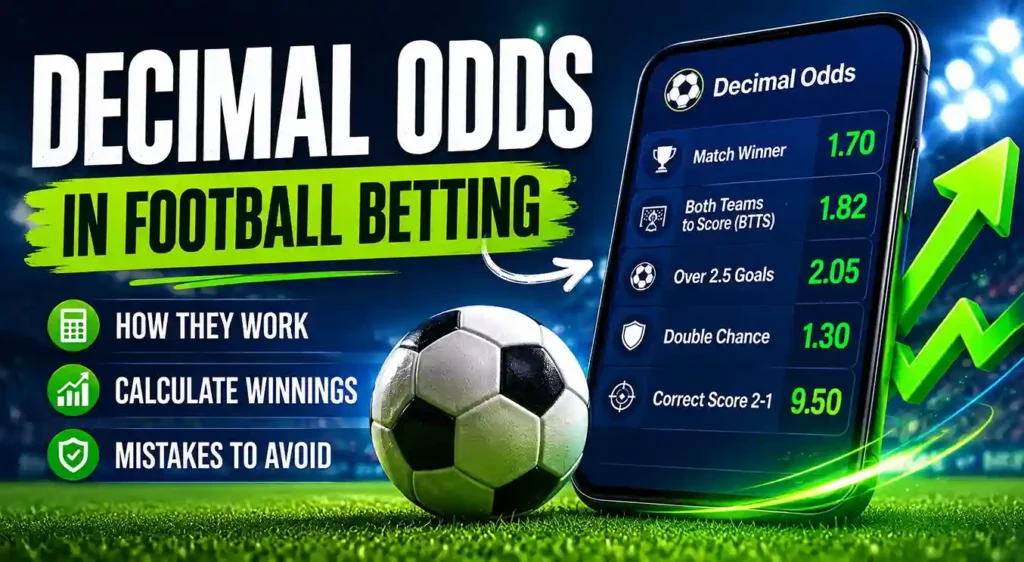
Decimal odds are the most common format in Europe, Africa, and Nigeria. They are also the easiest for beginners to understand.
Example:
- Odds: 2.50
- Stake: ₦10,000
Potential return:
- ₦25,000
This includes:
- ₦10,000 original stake
- ₦15,000 profit
The calculation is simple:
Return=Stake×Decimal Odds
Decimal odds are popular because bettors can instantly estimate potential payouts without complicated calculations. You can learn more in our detailed guide to decimal odds.
Fractional Odds
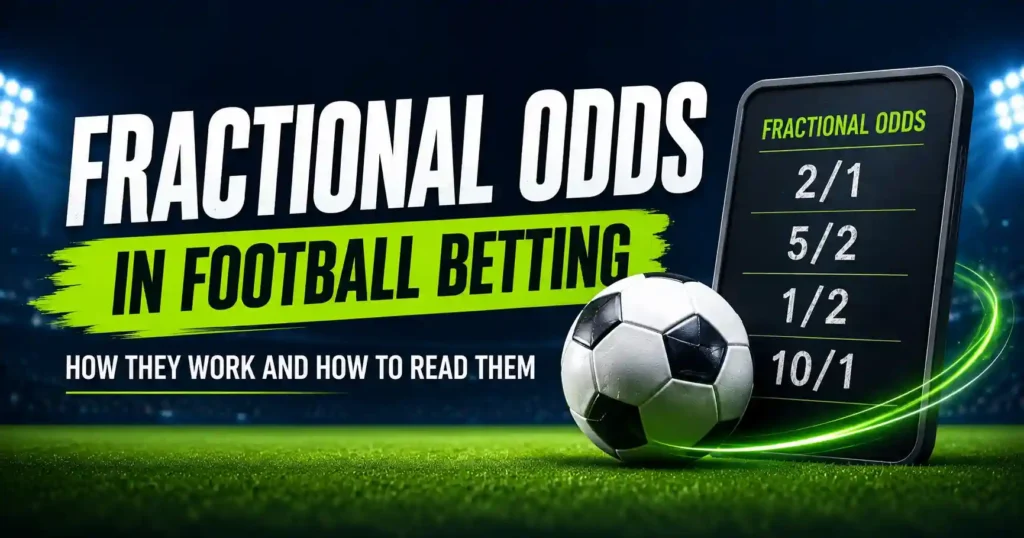
Fractional odds are mainly used in the United Kingdom.
Examples:
- 5/1
- 2/1
- 7/2
Fractional odds show profit relative to the stake. Although experienced bettors understand this format easily, beginners often find decimal odds simpler.
American Odds
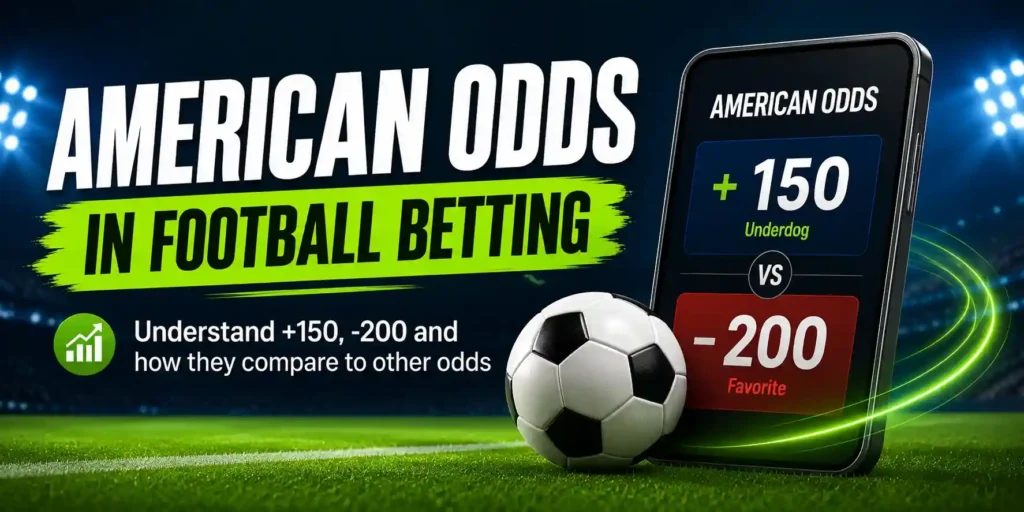
American odds format is common in the United States.
Examples:
- +200
- -150
Positive numbers show potential profit from a ₦100 equivalent stake. Negative numbers show how much must be wagered to win ₦100 equivalent profit. This system is less common among football bettors outside North America, but international sportsbooks may still display it.
How to Read Football Odds
Understanding how to read football odds is extremely important for successful betting.
Low Odds
Low odds usually indicate favorites.
Example:
- Manchester City — 1.35
This suggests bookmakers strongly expect Manchester City to win.
The payout is relatively small because the probability is considered high.
Medium Odds
Odds around:
- 1.80,
- 2.00,
- or 2.20
often represent balanced matches where both teams have realistic chances.
High Odds
High odds indicate underdogs.
Example:
- Team odds: 6.50
This means the bookmaker believes the team has a lower chance of winning.
However, successful bets produce larger returns.
Draw Odds
Football is unique because the draw is a common result. Draw odds typically range between:
- 3.00
- and 4.50
depending on the competitiveness of the match.
Implied Probability Explained
Football odds are directly connected to implied probability.
Implied probability converts betting odds into percentages representing the bookmaker’s estimated chance of an outcome happening.
The formula is:
P=Decimal Odds1×100
Example 1
Odds:
- 2.00
Calculation:
- 1 ÷ 2.00 × 100
Result:
- 50%
This means the bookmaker estimates a 50% chance of success.
Example 2
Odds:
- 4.00
Calculation:
- 1 ÷ 4.00 × 100
Result:
- 25%
The bookmaker believes the outcome has a 25% probability.
Why Implied Probability Matters
Many beginner bettors only focus on possible winnings. Experienced bettors focus on value.
Value betting happens when:
- you believe the actual probability is higher than the bookmaker’s estimate.
For example:
- bookmaker probability = 40%
- your estimated probability = 50%
In this case, the odds may contain betting value.
Understanding implied probability helps bettors:
- identify overpriced markets,
- compare bookmakers,
- avoid emotional betting,
- and make more rational decisions.
How Bookmakers Make Money From Odds
Bookmakers are businesses, and odds are designed to generate long-term profit.
They achieve this using built-in margins.
Understanding Overround
Suppose a match has these odds:
| Outcome | Odds |
|---|---|
| Home Win | 2.00 |
| Draw | 3.40 |
| Away Win | 3.80 |
If you convert all odds into probabilities:
- Home Win = 50%
- Draw = 29.4%
- Away Win = 26.3%
Total:
- 105.7%
The extra 5.7% represents the bookmaker’s margin.
This means:
- even if betting action is balanced,
- the sportsbook maintains a mathematical advantage.
Why Margins Differ
Some bookmakers offer:
- tighter margins,
- more competitive odds,
- and better value for bettors.
Others may increase margins significantly in smaller leagues or less popular markets.
This is why comparing odds across sportsbooks can improve long-term profitability.
Why Football Odds Change Before a Match
Football odds are dynamic and can move constantly before kickoff.
Several factors influence these changes.
Team News
If important players are injured or suspended, odds may shift dramatically.
For example:
- if a goalkeeper is ruled out,
- bookmakers may shorten odds on the opposing team.
Betting Volume
Heavy betting activity can force bookmakers to adjust prices.
If thousands of bettors back one outcome:
- bookmakers may lower those odds,
- while increasing odds on alternative results.
This helps balance liability.
Tactical Information
Changes in:
- formations,
- expected lineups,
- or coaching decisions
can affect football markets.
Weather Conditions
Extreme weather can influence:
- goals markets,
- over/under betting,
- and match tempo.
Rain, wind, or poor pitch conditions may reduce expected scoring.
Professional Bettors
Sharp bettors often influence markets early. If professional gamblers identify weak odds, bookmakers may react quickly.
This is one reason odds sometimes change rapidly hours before kickoff.
Common Mistakes Beginners Make With Odds
Many new football bettors misunderstand how odds work. Avoiding common mistakes can improve your betting decisions.
Betting Only on Favorites
Favorites win frequently, but low odds often provide poor long-term value.
A team priced at:
- 1.20
must win extremely often to remain profitable.
Chasing High Odds
Some beginners only focus on massive payouts.
However:
- high odds reflect lower probability,
- and longshot betting strategies can quickly drain bankrolls.
Ignoring Probability
Odds are not just payout numbers. They represent probability estimates.
Smart bettors always compare:
- bookmaker probability,
- against their own analysis.
Not Comparing Odds
Different sportsbooks offer different prices.
Even small odds differences matter over time.
Example:
- Bookmaker A = 1.90
- Bookmaker B = 2.00
Over hundreds of bets, these differences can significantly impact profitability.
Emotional Betting
Many football fans bet emotionally on:
- favorite clubs,
- rivalries,
- or national teams.
Successful betting requires discipline and objective analysis.
Understanding Value in Football Odds
One of the most important concepts in betting is value.
Value does not mean betting on the most likely team to win. Instead, it means finding odds that are higher than the true probability of an outcome.
For example:
- you believe a team has a 60% chance of winning,
- but bookmaker odds imply only 50%.
This creates a potential value opportunity.
Professional bettors focus heavily on:
- statistical analysis,
- market inefficiencies,
- and probability estimation.
They are not trying to predict every winner perfectly. Instead, they aim to consistently identify favorable prices.
Related Football Betting Markets
Once you understand football odds, it becomes easier to explore additional betting markets.
Popular football betting markets include:
- over/under betting,
- both teams to score (BTTS),
- handicap betting,
- double chance,
- correct score,
- and accumulator bets.
Each market uses odds differently, but the core principles remain the same:
- probability,
- bookmaker margin,
- and potential payout.
Learning how odds function across different football markets can help bettors make more informed decisions.
Tips for Understanding Football Odds Faster
If you are new to betting, these tips can help you learn odds more quickly.
Practice With Small Stakes
Start with low-risk wagers while learning calculations and market behavior.
Focus on Decimal Odds
Decimal odds are beginner-friendly and easier to calculate mentally.
Compare Multiple Bookmakers
Watching how different sportsbooks price the same match helps you understand market movement.
Study Probability
Learning basic probability concepts improves betting decisions significantly.
Track Your Bets
Keeping records helps identify:
- mistakes,
- profitable strategies,
- and emotional betting habits.
Conclusion
Football betting odds are much more than simple payout numbers. They represent probability, market opinion, bookmaker analysis, and betting risk.
Understanding how football odds work allows bettors to:
- read markets correctly,
- calculate potential winnings,
- identify betting value,
- understand implied probability,
- and avoid beginner mistakes.
Whether you are betting on match winners, over/under goals, handicap markets, or accumulators, odds remain the core element of every football wager.
The more you understand how bookmakers create and adjust football odds, the more informed and disciplined your betting decisions can become.
FAQ
1️⃣ What do football betting odds mean?
Football betting odds show the probability of a particular outcome in a match while also determining the potential payout from a successful wager. Lower odds usually indicate favorites, while higher odds represent underdogs with a lower chance of winning. Understanding odds helps bettors evaluate risk, compare markets, and make more informed betting decisions.
2️⃣ Why do football odds change before kickoff?
Football odds can change because bookmakers constantly react to new information and betting activity before a match starts. Injuries, lineup announcements, weather conditions, and heavy betting volume often cause markets to move. Odds adjustments help sportsbooks manage risk and maintain balanced action across all possible outcomes.
3️⃣ Which odds format is easiest for beginners?
Decimal odds are generally considered the easiest format for beginners because they simplify payout calculations. Bettors only need to multiply their stake by the displayed odds to calculate the total return. This format is widely used across Europe, Africa, and most international football betting platforms.
4️⃣ Can football odds predict the winner?
Football odds are based on probability estimates and statistical analysis, but they cannot guarantee match results. Bookmakers use data, team form, injuries, and market activity to create prices, yet football remains unpredictable. Unexpected events such as red cards, penalties, or late goals can completely change a match outcome.
5️⃣ What is implied probability in betting?
Implied probability is the percentage chance of an outcome happening according to bookmaker odds. It allows bettors to convert odds into probability values and better understand how sportsbooks rate each team or market. Learning implied probability is important for identifying value bets and comparing odds between bookmakers.
6️⃣ Why do favorites have low odds?
Favorites have lower odds because bookmakers believe they are more likely to win the match compared to underdogs. Since the probability of success is higher, sportsbooks reduce potential payouts to limit financial risk. Although favorites win more often, consistently betting on very low odds may not always provide long-term value.
7️⃣ How do bookmakers make money?
Bookmakers make money by building profit margins directly into betting odds through a system called overround or vig. This means the total implied probability across all outcomes exceeds 100%, giving sportsbooks a mathematical advantage. Even when bettors win individual wagers, bookmakers remain profitable over the long term.
8️⃣ Should bettors always choose the highest odds?
Choosing the highest odds is not always the best betting strategy because higher odds usually represent lower probability outcomes. Successful bettors focus on finding value rather than simply chasing large payouts. A smart betting approach combines probability analysis, discipline, bankroll management, and careful market comparison.

Read more >>
- Prediction for the match “Manchester City” vs “Everton” on October 18, 2025. The inspired attack of the “Toffees” will score in Manchester. - 14.10.2025
- Prediction for the Nottingham Forest vs. Chelsea match on October 18, 2025. There will be at least three goals in the Foresters’ game. - 14.10.2025
- Prediction for the match “Barcelona” vs. “Girona” on October 18, 2025. Barcelona’s defense will once again be unable to keep a clean sheet. - 14.10.2025


